Pike Place Market: What to See, Eat and When to Go
Pike Place Market is free, sits on no Seattle pass, and is worst at 11am on a Saturday. What to see, where to eat, and the two facts most guides get wrong.
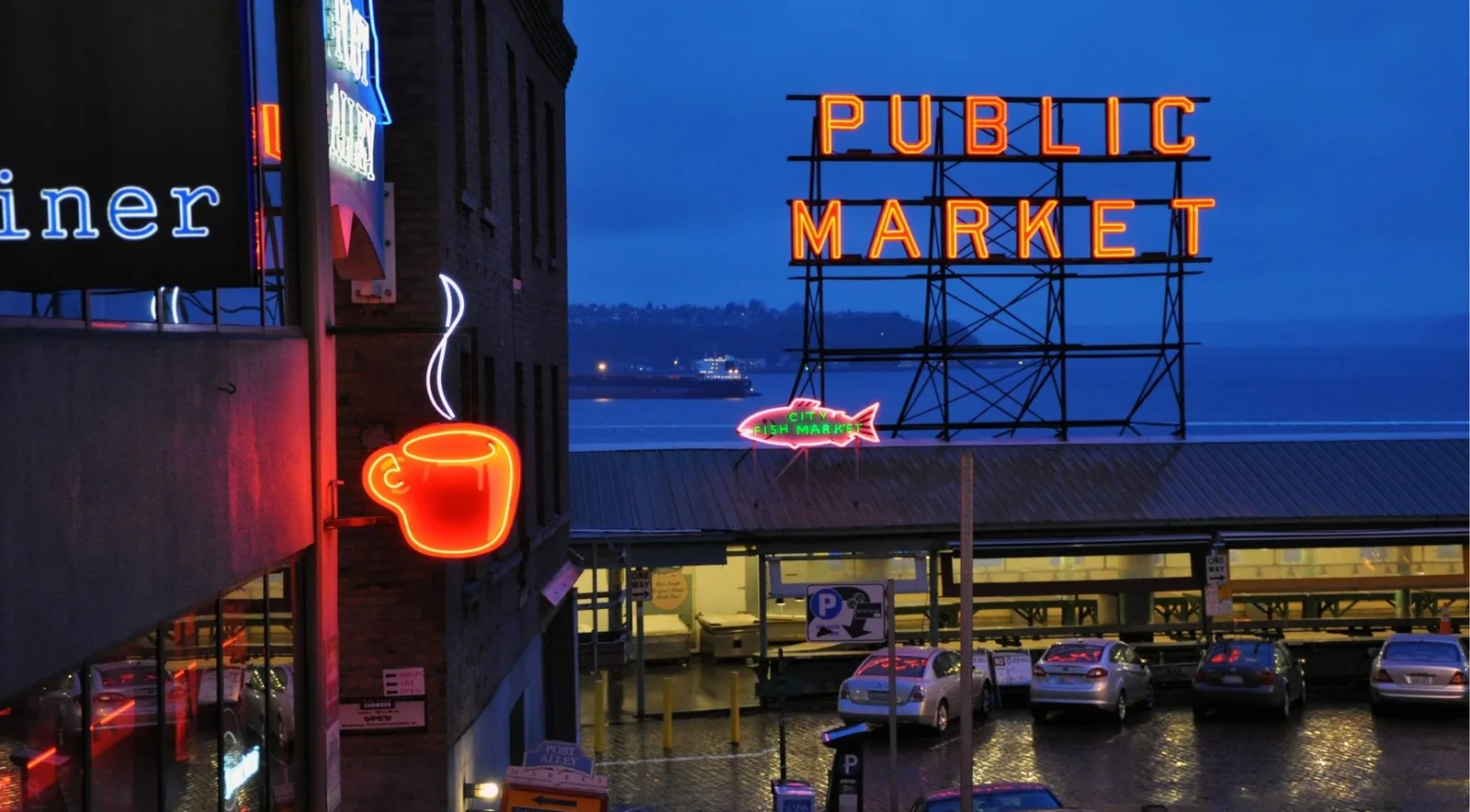
Pike Place Market is free to walk into, it is not on the Seattle CityPASS or on Seattle C3, and there is nothing to buy in advance. That makes it the one major Seattle attraction where the only planning decision that matters is when you turn up — and the answer is a weekday morning, ideally between 7 and 10am. Arrive at 11am on a Saturday in July and you will spend an hour shuffling through a crowd, conclude it is a tourist trap, and leave without seeing the half of it that is genuinely worth the trip.
Two things almost every guide gets wrong
Both of these get repeated constantly, and both are wrong in a way that matters if you are planning around them.
The Starbucks at 1912 Pike Place is not the first Starbucks. It is the oldest one still trading, which is a different claim. The original opened on 30 March 1971 at 2000 Western Avenue, founded by Gordon Bowker, Jerry Baldwin and Zev Siegl. When that building was scheduled for demolition the shop moved about 290 feet to 1912 Pike Place in 1976–77, and it has been there since. In June 2026 Starbucks reopened it as “The 1912 Pike Place Experience” with a reservation-based entry system intended to cut the queue — so check the current arrangement before you build a morning around it. Separately, the Starbucks on the 1st & Pike corner has closed for good; Salt & Straw opened in that space on 7 November 2025, opposite the fishmongers, and runs 11am to 11pm daily.
The Gum Wall has been cleaned more than once. You will still read that it was scrubbed in 2015 and never since. The first full clean was indeed November 2015 — three days of 260°F industrial steam, around 2,200 pounds of gum removed — but it was cleaned again in 2019, and again in November 2024. It regrows within months, so what you see is a few years’ accumulation rather than three decades of it. It is in Post Alley beside the Market Theatre box office.
Other experiences you might enjoy
The Market is central to almost everything downtown: the Seattle Aquarium and the waterfront are minutes away, and the Space Needle is a monorail ride north.
What the Market actually is
Pike Place opened on 17 August 1907, created by city ordinance after Seattleites got angry about price-gouging middlemen — the trigger, famously, was the price of onions rising roughly tenfold. Eight or so farmers sold from wagons on the first day and were swamped by thousands of shoppers. Frank Goodwin’s arcade building, the covered stretch you now think of as the Market, opened that November.
By the 1960s the city had written it off as a “ramshackle firetrap” and planned to level it for redevelopment. The architect Victor Steinbrueck ran a citizen campaign against that, and in November 1971 Seattle voters passed an initiative creating a seven-acre historical district and a commission to police it. That vote is why the Market still looks like itself.
It is run today by the Pike Place Market Preservation & Development Authority — a not-for-profit public corporation chartered by the city in 1973, with a twelve-member volunteer council. The PDA rehabilitates the buildings, protects farm and food retail, and funds low-income social services on site. It also licenses every paid tour operator working in the district, which is a genuinely useful consumer protection: if a food tour is running inside the Market, it has been pre-approved.
Scale, honestly stated, because sources disagree: roughly 200-plus independently owned shops and restaurants, around 80 farmers, somewhere between 150 and 190 craftspeople, and 400 to 500 residents living in the Market’s housing. Visit Seattle puts footfall at about 10 million people a year; you will see 15 million quoted elsewhere. Pike Place Fish alone claims up to 10,000 visitors a day.
The layout — and the route that works
This is the part most guides skip, and it is the reason people miss the good bits. The Market is a nine-acre district on a steep hillside, dropping several levels towards Elliott Bay. What looks from the street like one arcade is six or seven connected buildings.
- Main Arcade — the street-level stretch under the clock and neon sign. Pike Place Fish, the flower stalls, the produce high stalls.
- North Arcade — continues north towards Victor Steinbrueck Park. Craftspeople and farm tables. The daily “roll call” that assigns day-stall positions happens near here around 9am.
- Down Under — the lower levels beneath the Main Arcade, and the single most-missed part of the Market. A labyrinth of small owner-operated shops.
- Post Alley — brick pedestrian alley. The Gum Wall, The Pink Door, Pike Place Chowder.
- Economy, Sanitary and Corner Markets — the east-side buildings, more food and shops.
- MarketFront — the 2017 expansion on the Western Ave side, with Elliott Bay views and Billie the Piggy Bank.
A route that covers it in about two hours: start at Rachel the Pig under the clock, work the Main and North Arcades, drop into the Down Under, come back up and cross to the Sanitary and Corner Markets, then exit down Post Alley.
What to see
Pike Place Fish Market, at the corner of Pike Street and Pike Place, is the thing everyone comes for and the thing most likely to disappoint, purely because of expectations. The fish throwing is real. It has no showtime. Fishmongers throw a fish when a customer buys one, which is why people stand around the corner for twenty minutes seeing nothing. The tradition started in the early 1980s as a shortcut to save walking, the stall has been there since 1930, and the staff bought the business from owner John Yokoyama in 2018. Come early if you want to see it without being four rows back.
Rachel the Pig is the bronze piggy bank under the clock, and she is a working donation box — about $20,000 a year goes to the Market Foundation’s social services. Sculpted by Georgia Gerber of Whidbey Island, dedicated on the Market’s 79th birthday in 1986, and named after a real 750-pound prize pig from the 1985 Island County Fair. Her cousin Billie arrived in 2011 and sits on the MarketFront.
The “Public Market Center” neon sign and clock dates from 1927 and is one of the oldest surviving pieces of neon on the West Coast. It is also the reason every photo of Seattle you have ever seen looks the same.
The Gum Wall is in Post Alley, and your reaction to it will be immediate and final.
What to eat
The Market is a better eating destination than a shopping one. If you have around two hours and want the highest hit rate, the shortlist is Beecher’s, Piroshky Piroshky, Pike Place Chowder and Daily Dozen Doughnut Co. — all four are counter service, all four have queues that move, and together they are a meal.
The fuller list, roughly by what they are known for:
- Beecher’s Handmade Cheese (1600 Pike Place) — the “World’s Best” mac and cheese, with cheesemaking visible through the window.
- Piroshky Piroshky — Russian handheld baked pastries. Long line, fast line.
- Pike Place Chowder (Post Alley) — award-winning New England clam chowder. Order the sampler flight or a bread bowl.
- Daily Dozen Doughnut Co. — tiny fresh mini-doughnuts, going since 1978.
- Ellenos Real Greek Yogurt — the one people come back for.
- Le Panier — French bakery, here since 1983.
- DeLaurenti Specialty Food & Wine — Italian deli and grocery; the sandwich counter is the move.
- Three Girls Bakery — one of the oldest tenants in the building, established 1912.
- Mee Sum Pastry — humbao, the barbecue pork buns.
- Rachel’s Ginger Beer — fresh ginger beer and floats.
- Storyville Coffee — upstairs in the Corner Market, and hard to find on purpose.
- Biscuit Bitch — biscuits and gravy, no subtlety.
- Salt & Straw (102 Pike St) — the newest arrival, opposite the fishmongers, with a “Pike Sundae” built with Pike Place Fish Market.
For a sit-down meal you need to have booked. The Pink Door (1919 Post Alley) is Italian-American, has been running since 1981, has an unmarked pink door, an Elliott Bay patio and trapeze and cabaret acts over dinner — reservations strongly recommended, and it is closed Sunday and Monday. Matt’s in the Market, Café Campagne, Lowell’s (multi-level, bay views, since 1957) and the Athenian (since 1909) are the other names worth knowing.
Do you need a food tour?
Only if you want curation and orientation rather than food per se. Every paid operator inside the district is PDA-licensed, so the choice is about format, not legitimacy. Our full breakdown of what each one actually feeds you is in the Seattle tours and day trips guide, but the short version is that the Chef-Guided Food Tour is the deepest-rated option in the city — 4.9 from 1,035 GetYourGuide reviews, from $75 — with nine stops of small bites that the operator says most people treat as a meal. It is not suitable if you are gluten-free, dairy-free or vegan.
Skip a tour if you are a confident eater who has read the list above. Take one if it is your first day in Seattle, you want the history alongside the food, and you would rather not make eleven decisions on an empty stomach.
When to go
Hours vary by business type, which trips people up more than any single closing time. Per the Market’s own Plan Your Visit page: breakfast and fresh produce and seafood from 7am; farm tables 9am–4pm; the crafts market 11am–4pm; Down Under shops roughly 11am–5pm; restaurants 7am–2am depending on the restaurant; public restrooms 8:30am–6pm.
The Market is open 363 days a year — it closes only on Thanksgiving and Christmas Day.
- Best window: a weekday morning, 7–10am. Vendors are setting up, the fishmongers are unobstructed, and you can actually stand still.
- Worst window: 11am–3pm Thursday through Monday, and worse again on summer cruise-ship days.
- Seasonality: year-round. Farm stall inventory changes with the season but the stalls are always there.
A few dated events are worth checking rather than planning around, because the Market moves them: the Flower Festival on Mother’s Day weekend (9–10 May 2026, free), the Great Figgy Pudding Caroling Competition in early December (5 December 2026), and a summer supper event rebranded “Sunset on the Sound” for 2026.
Getting there, and why not to drive
The main entrance is at First Avenue and Pike Street. Take transit.
- Link light rail — Westlake and Symphony stations are each about 0.3–0.4 miles away, a downhill seven to ten minutes.
- Buses — Third Avenue is two blocks east, with RapidRide C, D and E plus local routes.
- From the waterfront — the Overlook Walk, or the older Pike Street Hillclimb stairs.
- The Monorail does not come here. It runs Seattle Center to Westlake only, which is a common and expensive misunderstanding.
The Overlook Walk opened on 4 October 2024 and is the single biggest change to visiting the Market in years. Built on the footprint of the demolished Alaskan Way Viaduct as part of the roughly $806 million waterfront programme, it bridges a nearly 100-foot vertical drop, is step-free with elevators, and is open daily 7am–10pm. It puts the Market under three minutes from the waterfront and the Seattle Aquarium, which used to be a genuinely unpleasant climb.
If you must drive, the Public Market Parking Garage has three entrances (1531 Western Ave, 1901 Western Ave, 1530 Alaskan Way), 800-plus stalls, EV charging and a 6ft 8in height limit. Rates after the June 2025 change run $8 for the first hour, $16 for two, $24 for three, $32 for four, $36 up to ten hours and $40 up to 24 — with a $13 Early Bird all-day rate. Many merchants validate. Rates change, so treat these as the shape of the pricing rather than a quote.
One more thing if you are driving: since April 2025 the PDA and SDOT have run a pilot restricting non-essential traffic on Pike Place itself during peak daytime hours, with deliveries, disabled-placard vehicles and emergency vehicles still permitted. It has been extended into 2026 and full closures apply on World Cup match days and major holidays. It changes often — check the Market’s Plan Your Visit page close to your date.
Accessibility
Better than the hillside suggests, but not uniform. There are 19 disabled parking spaces — three on Pike Place and sixteen in the garage near the elevators — and elevators and ramps throughout the buildings. Wheelchair and pushchair users should plan around the garage elevators and the Overlook Walk rather than the street-level slopes. Parts of the Down Under involve stairs and uneven cobbles and are the least accessible section. Public restrooms are open roughly 8:30am to 6pm. The outdoor and common areas are largely dog-friendly, but individual food businesses generally are not, service animals excepted.
Where it fits if you have a pass
Pike Place is free, so there is nothing for a pass to cover — and neither the CityPASS nor C3 includes it or any Market tour. What it is good for is being the free anchor of a paid day, because three passable attractions sit within a few minutes’ walk:
- The Seattle Aquarium is at the bottom of the Overlook Walk and is always included on the CityPASS — see what the Seattle CityPASS includes.
- Argosy’s harbor cruise leaves from Pier 55, a few minutes south along the waterfront, and is one of the CityPASS choose-three options.
- The Seattle Art Museum and Sky View Observatory are both downtown and both C3-only picks — covered in our Seattle C3 guide.
Build the morning around the Market at 8am, then walk down for a paid attraction once the crowds arrive. It is the most efficient half-day in the city, and Pioneer Square and the Underground are a fifteen-minute walk south if you want a third stop.
Is it a tourist trap?
Partly, and it depends entirely on what you buy. The souvenir stalls are overpriced, the fish throwing is intermittent, the Gum Wall is exactly as hygienic as it sounds, and at peak hours the crowd genuinely does ruin it. Those complaints are fair.
The defence is that the PDA restricts stalls to actual local farmers, fishmongers and craftspeople — you cannot buy imported tat from a day-stall vendor here the way you can at most comparable markets — and plenty of Seattleites still come for flowers, produce, cheese and spices, even if almost nobody does a weekly grocery shop here any more. If you want a working neighbourhood farmers’ market rather than a historic district, the Ballard Farmers Market on Sundays is the honest alternative.
The version of Pike Place that people call a trap and the version people call the best thing in Seattle are the same place, three hours apart.
A note on safety
The Market and the waterfront are busy and generally considered safe in daylight. The Third Avenue corridor two blocks east, and parts of Belltown, have a longstanding reputation for visible drug activity and petty crime; the city added cameras, dedicated officers and a real-time crime centre along Third Avenue in 2025. The trend has been downward: Seattle Police reported an 18% citywide reduction in crime in 2025, with 37 homicides against 58 the year before, and downtown violent crime down about 15% year-over-year. Normal city precautions apply — mind your belongings in a dense crowd, leave nothing in a parked car, and do not linger on Third Avenue after dark.
Frequently asked questions
Is Pike Place Market free? Yes. There is no admission, no ticket and nothing to book. You pay only for what you buy.
Is Pike Place Market on the Seattle CityPASS or C3? No. Neither pass includes it, because there is no admission to bundle. No Market food tour is on either pass either.
What time should I go? A weekday between 7 and 10am. Avoid 11am to 3pm from Thursday to Monday.
What are the opening hours? They vary by business. Produce, seafood and breakfast start at 7am; farm tables run 9am–4pm; craft stalls 11am–4pm; the Down Under shops roughly 11am–5pm. Open every day except Thanksgiving and Christmas.
Where do I park? The Public Market Parking Garage on Western Ave and Alaskan Way, with a $13 Early Bird all-day rate and merchant validation at many shops. Better still, take Link light rail to Westlake or Symphony and walk down.
Is the Starbucks there the first one? No — it is the oldest still operating. The original was at 2000 Western Avenue and closed when the building came down; the shop moved to 1912 Pike Place in 1976–77.
How long do I need? Two hours covers the arcades, the Down Under and Post Alley with a couple of food stops. Half a day if you want a sit-down meal or a tour.
The bottom line
Pike Place is free, it is on no pass, and the only way to get it wrong is to arrive at the wrong hour. Go on a weekday morning, walk the Main Arcade, then go down the stairs into the Down Under that most visitors never find. Eat at four counters rather than one restaurant. Then take the Overlook Walk down to the waterfront and spend your pass on something that actually charges admission.
See Seattle for Less — One Pass, Five Top Attractions
Seattle CityPASS bundles the Space Needle, Seattle Aquarium, an Argosy harbor cruise, and your choice of top attractions into one mobile ticket — rated 4.7/5 by 800+ travelers and saving up to 47% off the gate. Free cancellation.
Check CityPASS Prices